(As told through the voice of Mohamed Al Khalidi)
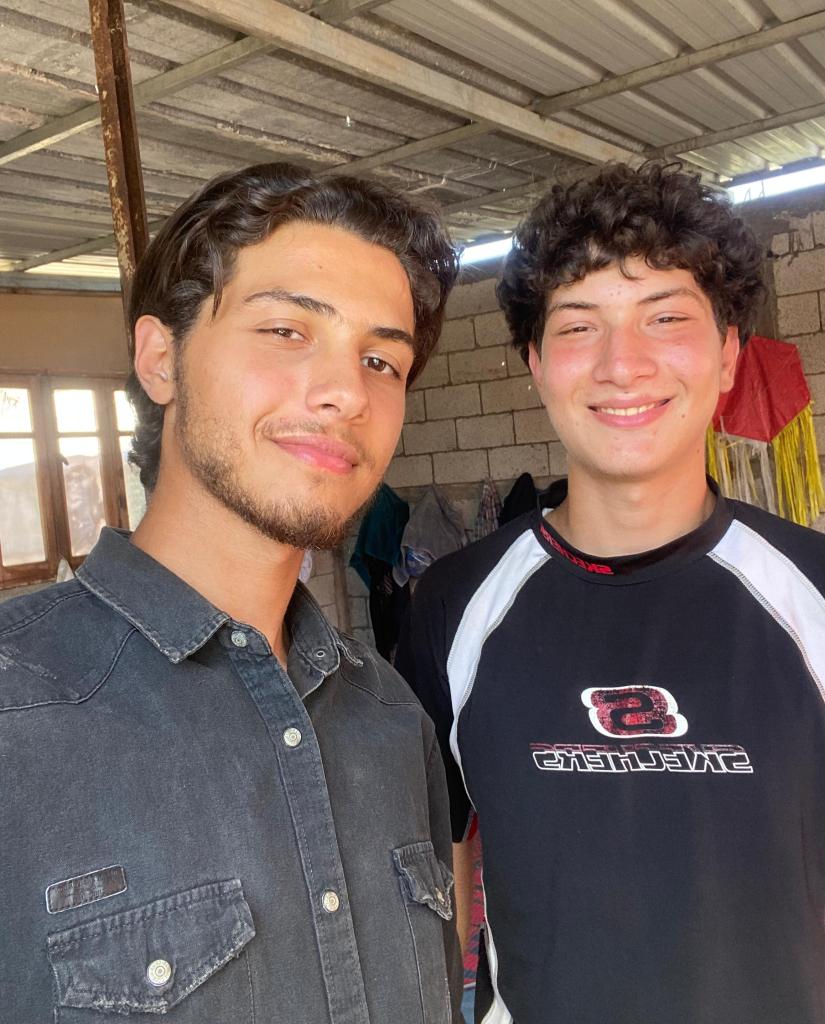
“Let me tell you what happened to me…”
That’s how Mohamed began. His voice wasn’t loud. It didn’t need to be. It came from a place deeper than sound—shaped by grief, exhaustion, and the echo of war that never quite leaves your body.
“One morning, we woke up to heavy gunfire,” he said.
“It was aimed directly at us.”
They were in an area declared safe. That word meant nothing in Gaza, but it was all they had to hold on to.
“I was the first one up. I stepped outside the tent to see what was going on. I didn’t stay long—there was random gunfire coming from drones. You could hear the buzzing, and then the shots would follow.”
In front of them was an old farmhouse. Its thick walls had become their only shield. Mohamed crouched near the door. He thought he had made the right decision.
Then his brother Zain woke up.
“He asked me if it was safe to go to the bathroom,” Mohamed said.
“I told him no. I said I’d go first. We argued—just for a second. I told him, ‘Fine, go.’”
Zain walked past him. Just a few steps.
Two meters.
“Then we heard the gunshot,” he said.
“It pierced the thin metal of the tent wall and hit him straight in the heart.”
They hadn’t seen the drone—just a small quadcopter, floating overhead, silent until it wasn’t. The bullet knew where to go.
“Everything after that was a blur,” Mohamed said.
“I ran out to get help. I found a car, screamed at the driver to take us to the hospital. I didn’t understand how serious it was. I thought… I thought he could survive.”
But the bullet had gone through his chest. He was gone before they reached the hospital.
“Since that day,” Mohamed said, “I’ve never been the same.”
There are many ways war changes you. Some are loud and immediate—bombs, collapses, screams. Others settle in slowly, like fog. Zain’s death was both. It tore something open in Mohamed that has never closed.
After that, they were displaced five times. Five different shelters. Five versions of a life that wasn’t really a life anymore. He moved like someone carrying something broken that could never be fixed.
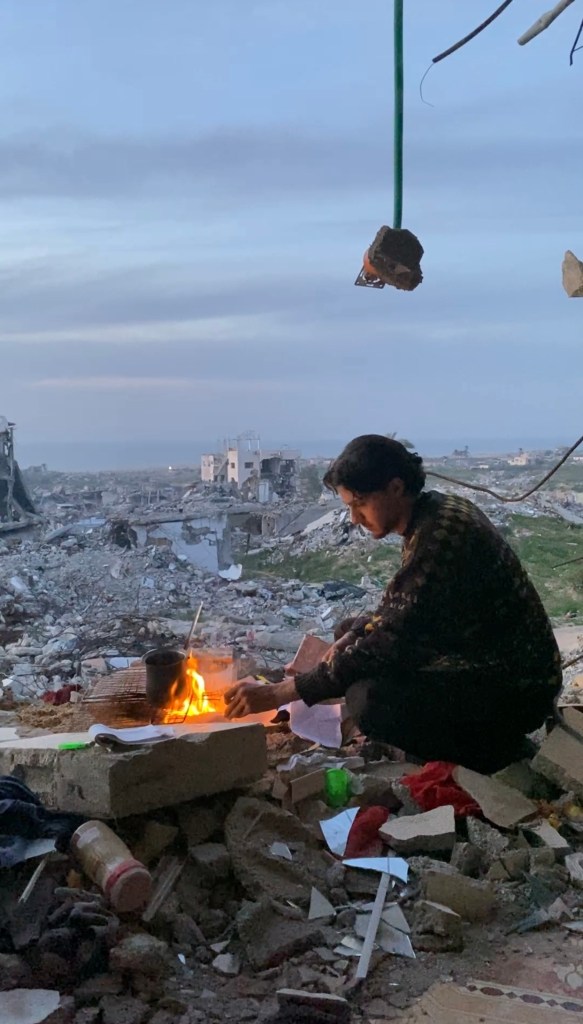
Every place they arrived felt more temporary than the last. A tent. A classroom turned into shelter. Then another tent. And then… nothing.
“You learn how to pack in a way that protects your memories,” he said. “The smell of Zain’s blanket. A photo. His notebook. It’s all I could keep.”
But after weeks, maybe months, it’s hard to track time when every day feels like survival, there was a word. A corridor might open. A chance to return. Not home exactly, but what was left of it.
He made the journey alone, one step at a time, not knowing what he would find.
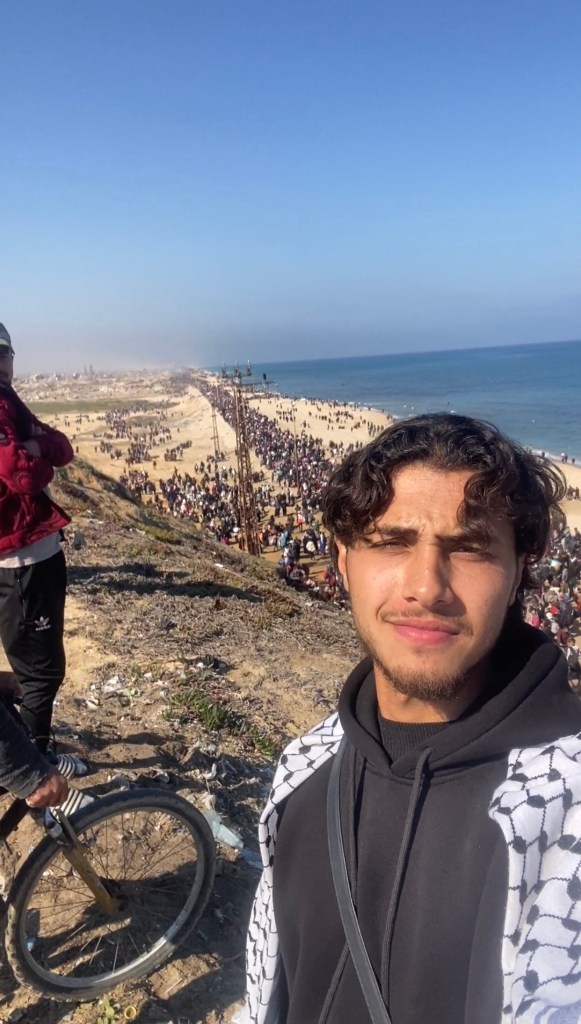
When Mohamed finally arrived, the reality hit harder than expected.
“When I picked up my phone to record a video of the house,” he said, “I found that most of the homes were destroyed. So I went outside to show the world the truth.”
The farther north he walked, the worse it got.
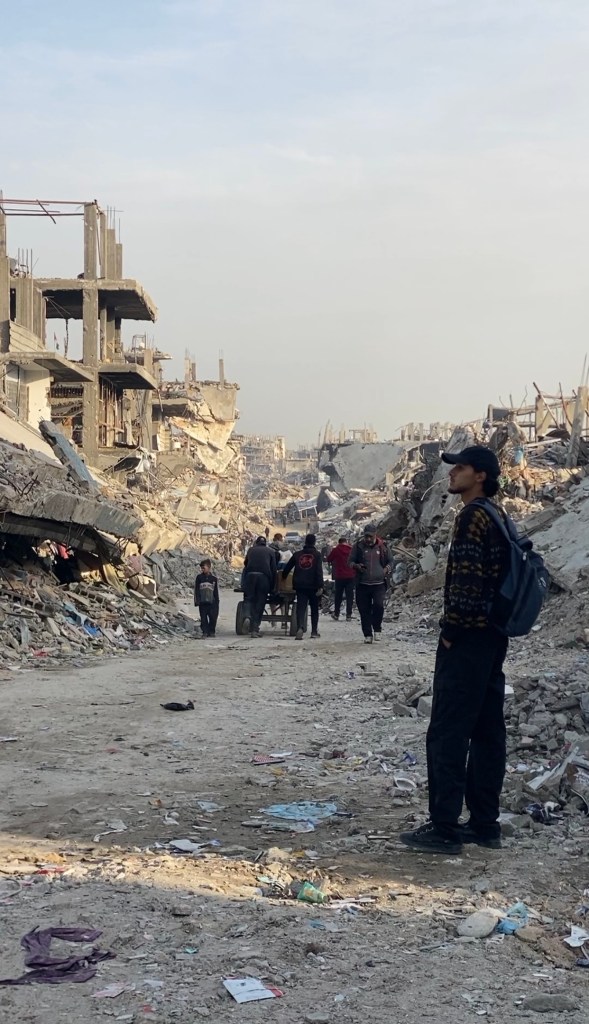
“I was shocked by the amount of destruction — the devastation was unimaginable. Entire neighborhoods erased. Streets I knew by heart, now turned to ash and twisted metal.”
And yet, somehow, his family’s home was still there. Broken, yes. Scarred and cracked. But standing.
“With every step, I kept thanking God that our house was still standing,” he said.
“But at the same time, my heart ached deeply… because the house was missing someone dear — my beloved brother.”
He stood in front of it, phone in hand, eyes full of grief.
“I kept thinking: Take the house. Take everything… just bring my brother back to me.”
Inside, the air was thick with memory. Zain’s belongings still sat in place. His clothes. His bed. The silence was louder than any explosion.
“That house became my last link to him,” Mohamed said.
“Everything else had been taken.”
He began cleaning. Carefully. As if dusting off memory itself. He swept. He folded. He touched the walls like they were the skin of a loved one long gone.
Outside, Gaza remained in ruins. More than 90% of homes damaged or destroyed. Tens of thousands killed. Thousands more missing. And among the survivors—millions of unspoken stories like Mohamed’s, buried in the dust.
“People think the worst thing is death,” he said.
“But sometimes, it’s what comes after. The ordinary things you never get to do again—like arguing over who goes to the bathroom first. Like hearing your brother’s voice.”
He planted mint outside. Later, tomatoes. It was something to tend. A small act of defiance. A gesture of life.
One day, he shared a video. No plan. No performance. Just truth.
“I didn’t do it to be strong,” he said.
“I did it because I didn’t know where else to put the pain.”
He still has hard days. The grief doesn’t leave. It just changes shape. But he has learned to walk alongside it. And he has learned to speak, not just for himself, but for the many who can’t.
For the children too afraid to sleep.
For the mothers who carry nightmares in silence.
For the men who sit alone with memories they don’t know how to name.
Now, every time he returns to that house, he stands in silence. He listens. He breathes. He remembers the last two meters he ever walked beside his brother.
“I still hear his voice,” Mohamed said.
“Still see him walking out of the tent. Still think: what if I had gone first?”
There are no answers in Gaza. Only echoes. Only ruins.
And yet, something remains. A house. A shirt in the wardrobe. A scar that will never fade.
“The war took my brother,” he said.
“But it didn’t take the bond between us. It didn’t take my voice. Or my memory. Or my right to tell this story.”
“I don’t want revenge,” he said, softly. “I just want a normal life. A quiet one. That’s my dream.”
And maybe, after hearing his story, it becomes part of yours too. Maybe we carry it with us, not as a burden, but as a reminder of how strong the human spirit can be, and how much healing the world still owes to people like Mohamed.
Because no one should have to survive alone.
This is not a story about hope.
It’s a story about witness. About love and loss in a land made of rubble.
About a boy who stepped outside—and never returned.
And another who keeps walking, carrying the weight of silence and the truth of what remains.
Because the bombs can take your home.
They can take your family.
But they cannot take your truth.
And that is what the bombs couldn’t take.
 Frontline Pulse