
“Sees no light.”
That was the final line in the medical report about Taha, a fifteen-year-old boy from Gaza. A boy who once saw the world in colors so vivid they danced across the pages he drew on. A boy whose imagination soared far beyond the walls of the refugee camp he called home. A boy who now lives in darkness.
Taha was born into a displaced family from northern Gaza, forced to seek shelter in the overcrowded Al-Bureij refugee camp. His family of ten includes three members with special needs. Taha is the fourth child—gentle, quiet, and gifted. He didn’t speak much, but his drawings spoke volumes. He sketched birds flying over peaceful skies, children playing in fields of green, and homes filled with laughter. His art was his escape, his voice, his hope.
His father used to say, “Taha doesn’t just draw—he sees the world the way it should be.”
But war has a way of stealing even the most innocent dreams.
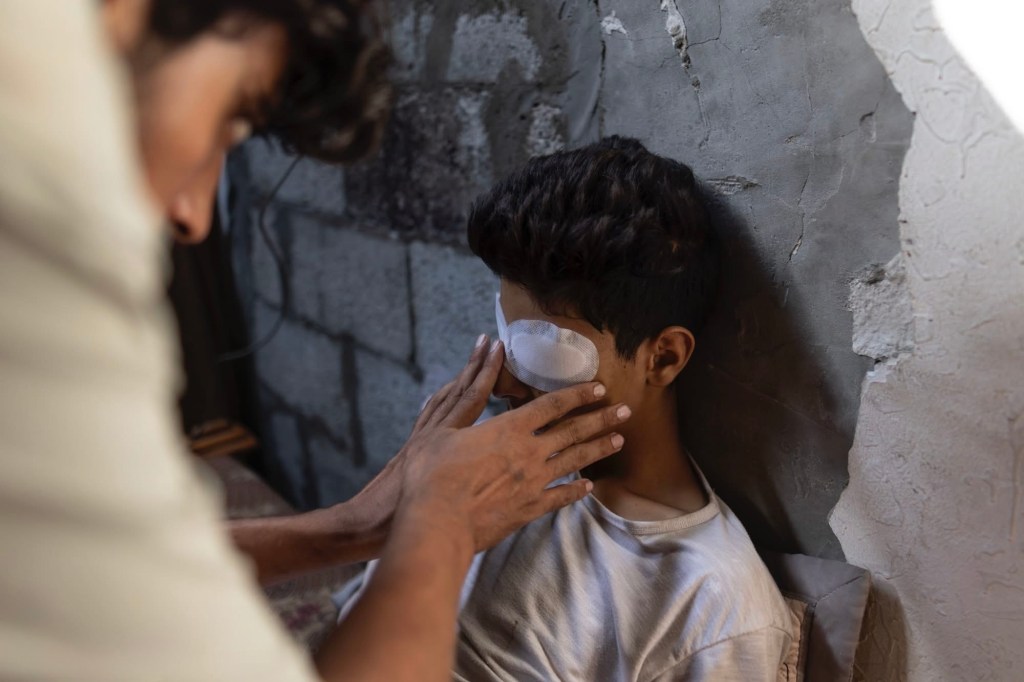
In the early days of the conflict, a missile struck near their shelter. In a single moment, Taha lost his father and his older brother. The grief was unbearable. His mother, Um Taha, held the family together with trembling hands and a broken heart. Taha stopped drawing. His colors faded. His silence deepened.
Then, on July 27, 2025, while waiting for humanitarian aid in the Netzarim area, a bullet pierced Taha’s head. It didn’t take his life—but it took his sight. The boy who once saw the world in radiant hues was plunged into permanent darkness.
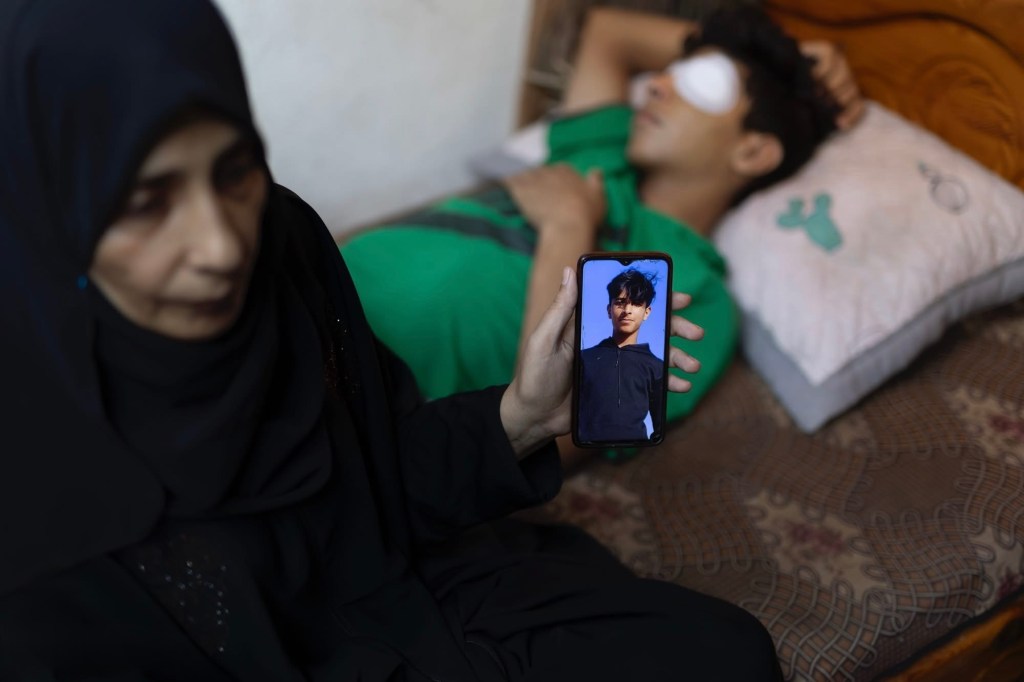
The doctor’s words were clinical: “Sees no light.”
But for his mother, they were a death sentence for his dreams.
“I wish I could give him my eyes,” she said, her voice cracking with sorrow. “I would give him my sight, my soul, anything… just so he could see again.”
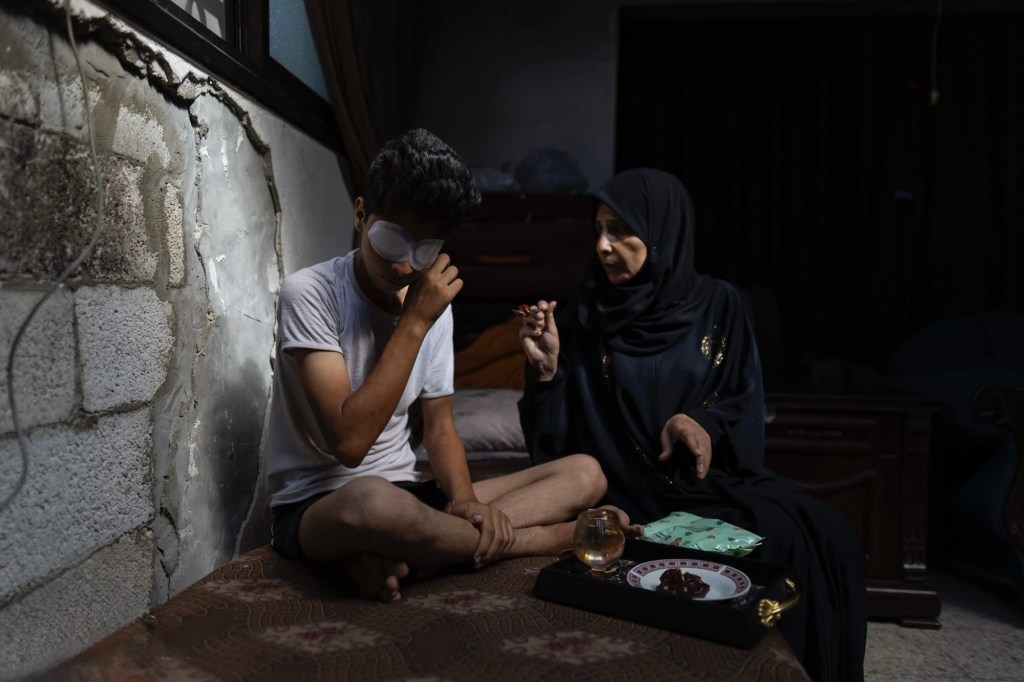
Today, Taha sits quietly in a corner of their shelter, his fingers tracing the outlines of his old drawings. He remembers the colors, the shapes, the joy. He asks his younger siblings to describe the sky to him, the birds, the flowers. Sometimes he smiles. Sometimes he cries silently.
His only dream now is to travel—to find a place where, maybe, there’s a chance for treatment. A chance to see again. A chance to draw again.
His mother, who has sold everything she could to buy medicine and food, says:
“If I were given a choice between food and travel, I would choose travel for Taha. Let him be hungry, but let him have hope. Maybe somewhere in this world, there is a place that can bring back his light.”
This story was shared with me by a national doctor who worked alongside me in Gaza. He had cared for Taha, witnessed his suffering, and saw the pain etched into the faces of his family. He entrusted me with this case, hoping that by sharing it, we might help bring attention, compassion, and possibly a path forward for Taha.
In the heart of Gaza, amid rubble and grief, a mother and her blind son hold onto a fragile dream. Not of riches, not of comfort—but of light. Of sight. Of a future where Taha can once again draw the world he longs to see.
This is not just a story of loss and injustice. It is a story of love. Of resilience. Of a boy who once painted the world with hope—and who still dares to dream of seeing it again.
 Frontline Pulse